iPhone X vs iPhone XR: Unveiling the Key Differences
Difference between iPhone X and iPhone XR
Are you curious about the disparities between the iPhone X and the iPhone XR? While both are remarkable devices, there are notable differences to consider. The iPhone X boasts an OLED display, whereas the iPhone XR features an LCD screen. Additionally, the iPhone X includes a dual-camera system, providing enhanced photography capabilities compared to the single-camera setup of the iPhone XR. Explore further to discern which model aligns with your preferences. Discover our range of Apple products and make an informed choice!Here’s an overview:
- Introduction to the iPhone Legacy
- Design Evolution: X vs XR
- Display Technologies: OLED vs Liquid Retina
- Comparing the Processors: Performance Face-Off
- Camera Capabilities: A Close-Up
- Battery Life and Power Efficiency
- Software and Ecosystem: iOS Updates and Support
- Storage Options and Pricing Variations
- Face ID and Security Features
- Color Choices and Aesthetics
- Environmental Considerations and Build Quality
- Connectivity and Networking
- Audio and Sound Enhancements
- Analyzing User Experience and Interface
- The Verdict: Which iPhone Suits Your Needs?
Introduction to the iPhone Legacy
The iPhone, since its debut in 2007, has revolutionised the smartphone industry. Over the years, it has become synonymous with innovation, quality, and performance. The legacy of the iPhone is defined by its continuous refinement of design, its commitment to user experience, and the integration of cutting-edge technology that has often set the standard for competitors.
Apple’s persistent evolution of the iPhone has led to a diverse lineup, each iteration marked by its distinctive capabilities that cater to different consumer needs and preferences. The arrival of the iPhone X in 2017 was a milestone—it marked the tenth anniversary of the iPhone and introduced features that have come to define modern smartphones, such as edge-to-edge display and facial recognition technology.
In contrast, the iPhone XR, released in 2018, was unveiled as a more affordable yet equally capable model. While retaining numerous state-of-the-art features from premium models, it was designed to deliver an alternative without compromising the core experience that users have come to expect from Apple’s signature device.
Comparing the iPhone X and iPhone XR sheds light on Apple’s strategic positioning within the market. Analysing their differences not only reveals the technological advances made in just a year but also illustrates how Apple balances innovation with accessibility. The legacy isn’t just about the technology within the devices; it’s also about the broader impact on user behaviour, industry standards, and global market trends. This analysis of the iPhone X versus iPhone XR will provide insight into how two seemingly similar models can cater to different market segments while upholding the prestige of the iPhone legacy.
Design Evolution: X vs XR
When scrutinising the iPhone X alongside the iPhone XR, the design evolution is noticeable, reflecting Apple’s focus on streamlined aesthetics and functionality.
The iPhone X, introduced in 2017, brought a radical new look to the iPhone lineup with a near bezel-less OLED display, omitting the iconic home button for the first time. This model marked the debut of the notch, housing an advanced TrueDepth camera system enabling Face ID. Its construction featured surgical-grade stainless steel edges bonded with glass on both the front and back, signifying a premium feel.
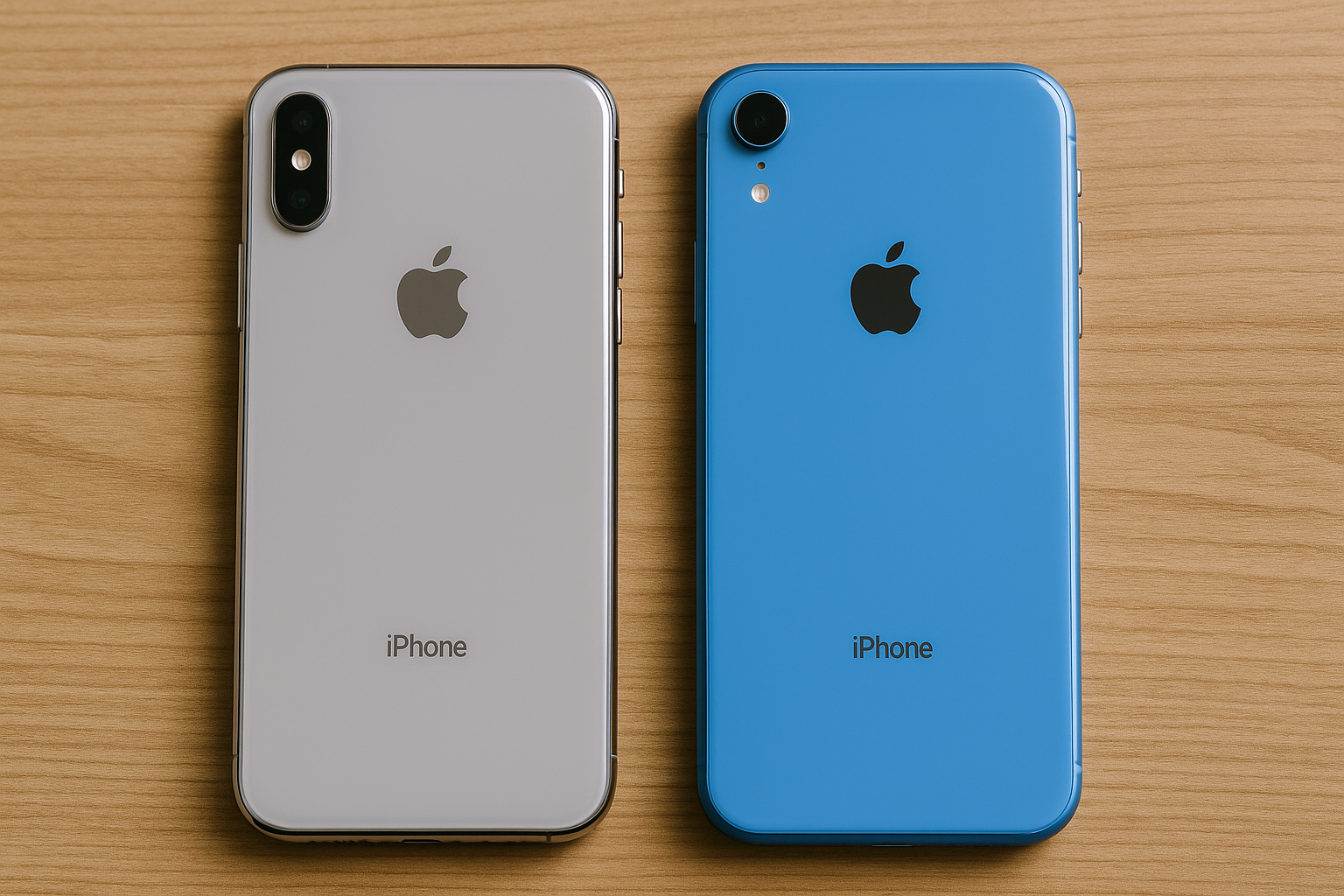
The iPhone XR, unveiled a year later, maintained the all-screen philosophy but with strategic adjustments. Its Liquid Retina display, although expansive, opts for an advanced LCD over OLED, striking a balance between high-quality visuals and cost-effectiveness. The XR’s design diverged with an aluminium frame instead of stainless steel and offered a wider array of colours, appealing to a more diverse market. The back glass, although similar at a glance, lacks the iPhone X’s dual-camera system, opting instead for a single-camera setup that still benefits from Apple’s photographic software ingenuity.
Both iPhones represented pivotal steps in Apple’s smartphone design evolution, carrying forward the language of edge-to-edge screens and facial recognition technology. Yet, each has its distinct place in the continuum:
- iPhone X: Premium build with OLED screen and dual-camera sophistication.
- iPhone XR: Broader appeal with an aluminium frame, LCD display, and an array of vibrant colours.
As such, both models exhibit Apple’s balancing act between innovation, market expansion, and consumer preference.
Display Technologies: OLED vs Liquid Retina
When comparing the iPhone X and iPhone XR, one of the most noticeable differences lies in their display technologies. The iPhone X features an OLED (Organic Light Emitting Diode) display, while the iPhone XR sports what Apple calls a Liquid Retina display, which is an advanced form of LCD (Liquid Crystal Display).
The OLED technology used in the iPhone X allows for deep blacks and a high contrast ratio because each pixel emits its own light, which can be completely turned off to achieve true black. This attribute also contributes to the device’s dynamic range and colour accuracy. Moreover, OLED displays generally have better response times and can be thinner than their LCD counterparts.
In contrast, the iPhone XR’s Liquid Retina display, while being an LCD, is one of the most advanced in its class. LCDs typically require a backlight to illuminate the pixels, which means black levels are not as deep compared to OLED. Consequently, the contrast ratio on the iPhone XR is lower than that of the iPhone X. However, Apple has implemented an edge-to-edge display design with a backlighting system that stretches into the corners, enabling the iPhone XR to deliver a more expansive colour range and accuracy than traditional LCDs.
- Resolution and Pixel Density: The iPhone X’s OLED display has a higher resolution and pixel density (2436x1125 pixels and 458 ppi) compared to the iPhone XR’s Liquid Retina display (1792x828 pixels and 326 ppi).
- Colour Accuracy and Brightness: The OLED display is capable of displaying HDR content and can reach a higher peak brightness level than the typical LCD. Liquid Retina in the iPhone XR offers industry-leading colour accuracy and a wide colour gamut, but does not support HDR in the same capacity as OLED.
- Power Efficiency: OLED displays are usually more power-efficient than LCDs; however, the iPhone XR’s Liquid Retina display employs advanced LED technology to optimise its power consumption.
Understanding these differences can help users in making a more informed choice based on their preferences for display quality and characteristics.
Comparing the Processors: Performance Face-Off
When analysing the performance distinctions between the iPhone X and the iPhone XR, their processors play a central part. The iPhone X is equipped with Apple’s A11 Bionic chip, which was a considerable advancement in mobile processing technology at its release. It features a 64-bit six-core architecture, with two performance cores and four efficiency cores designed for sophisticated tasks and power savings, respectively.
In contrast, the iPhone XR harnesses the power of the A12 Bionic processor. This iteration also operates on a 64-bit six-core architecture but offers notable improvements in both speed and energy efficiency due to its newer design. This next-generation Neural Engine is capable of performing an outstanding five trillion operations per second, a significant jump from the 600 billion operations the A11 could handle.
Other aspects come into play when evaluating these processors:
- Graphics performance is more robust on the A12 Bionic, which provides smoother visuals and better overall handling of graphics-intensive applications.
- Energy efficiency is optimised in the A12, as it is built with a 7-nanometre process technology, compared to the 10-nanometre process in the A11 chip. This advancement allows the iPhone XR to provide longer battery life under similar usage conditions.
- Machine learning tasks are executed with greater speed and efficiency on the A12, benefiting apps that use machine learning for features such as facial recognition and augmented reality.
For consumers, this translates into a snappier and more responsive experience on the iPhone XR, particularly noticeable when handling newer apps designed to leverage the A12’s capabilities. The iPhone X, while still remarkably capable, may show signs of its age as software requirements continue to advance.
Camera Capabilities: A Close-Up
When comparing smartphone cameras, the iPhone X and iPhone XR showcase distinctive features and performance. Both models inherit Apple’s reputation for high-quality imaging but cater to different user needs.
The iPhone X debuted with a dual 12-megapixel rear camera system, combining a wide-angle f/1.8 lens and a telephoto f/2.4 lens, enabling 2x optical zoom and digital zoom up to 10x. Its front camera offers a 7-megapixel TrueDepth system with f/2.2 aperture that supports advanced Portrait mode and Portrait Lighting, delivering selfies with striking depth-of-field effects.
In contrast, the iPhone XR houses a single 12-megapixel wide-angle rear camera with an f/1.8 aperture yet still supports Portrait mode using sophisticated software algorithms. The lack of a telephoto lens means the XR operates with solely digital zoom, up to 5x. It features the same TrueDepth front camera system as the iPhone X; however, it brings enhancements to Portrait Mode and Depth Control, allowing users to adjust the background blur in images.
Both devices employ Smart HDR, leveraging multiple technologies, including the A12 Bionic chip, for better highlight and shadow detail in photos. Video capabilities differ slightly—while the iPhone X can capture 4K video at 24, 30, or 60 frames per second, the iPhone XR adds 25fps to these options for added flexibility.
Key features such as optical image stabilization are available on both models, ensuring crisp images even in low-light conditions. Moreover, the True Tone flash with Slow Sync provides more uniformly lit backgrounds and foregrounds.
Overall, the iPhone X is tailored for avid photographers who value the versatility of a dual-camera system, whereas the iPhone XR offers a capable camera for general use, with certain enhancements to portrait photography.
Battery Life and Power Efficiency
When comparing the power performance between the iPhone X and the iPhone XR, users will find notable differences. The iPhone X is equipped with a 2716mAh battery, which can typically sustain a full day of moderate use. On the other hand, the iPhone XR boasts a larger 2942mAh battery, which Apple claims offers up to 1.5 hours more battery life than the iPhone 8 Plus, translating to slightly longer usage times than the iPhone X.
The difference in battery life can be attributed in part to the iPhone XR’s Liquid Retina LCD display, which is less power-intensive than the iPhone X’s Super Retina OLED screen. OLED displays have been known to consume more power, especially when displaying pure white scenes or interfaces, despite having the advantage of true blacks and higher contrast ratios.
Furthermore, the iPhone XR is powered by the more efficient A12 Bionic chip, which is Apple’s first 7-nanometer chip that is not only more powerful but also more efficient than the A11 Bionic chip found in the iPhone X. This enhancement ensures that the iPhone XR delivers better performance per watt and results in less energy consumption for day-to-day tasks.
- iPhone X Battery Capacity: 2716mAh
- iPhone XR Battery Capacity: 2942mAh
- Display Technology:
- iPhone X: Super Retina OLED
- iPhone XR: Liquid Retina LCD
- Processor Efficiency:
- iPhone X: A11 Bionic chip
- iPhone XR: A12 Bionic chip
It’s worth mentioning that both devices support wireless charging and fast charging, but they do not come with a fast charger in the box. Users looking to take advantage of quicker charge times will have to purchase an appropriate charger separately. Overall, the iPhone XR typically offers longer battery life and better energy efficiency compared to the iPhone X, which can be a decisive factor for users who prioritize battery performance in their usage.
Software and Ecosystem: iOS Updates and Support
When it comes to the iPhone X and XR, understanding how each device is supported by Apple through iOS updates and ecosystem integrations is crucial for users looking to make an informed choice.
Both the iPhone X and iPhone XR initially launched with different versions of iOS — the X with iOS 11 and the XR with iOS 12. Nonetheless, both devices have been recipients of Apple’s continual software updates, which include performance enhancements, new features, and security patches. This commitment to software updates ensures that both devices remain relevant and secure long after their release. For instance:
- Security: Regular iOS updates provide important security fixes that protect user data from emerging threats.
- Features: New iOS versions often introduce features that enhance the user experience or introduce entirely new capabilities.
The ecosystem integration that Apple devices enjoy is particularly notable. For both the iPhone X and XR, this includes:
- Seamless synchronization with other Apple devices such as the iPad, Mac, and Apple Watch.
- Access to a robust App Store with a wide range of apps optimised for various iPhone models.
- Continuity features such as Handoff, which allows users to start an activity on one device and continue on another.
While the longevity of updates for the iPhone X and XR is impressive, it is essential to note that the iPhone XR, being the newer model, may receive iOS updates for a longer period than the iPhone X. This is an important factor to consider for prospective buyers looking for a device with the longest possible support lifecycle.
Both models benefit from Apple’s dedication to user privacy and data protection, with updates often focusing on enhancing these aspects of the iOS experience. Users can expect a high degree of synergy between their iPhone and the wider Apple ecosystem, which remains a major selling point for both the iPhone X and the iPhone XR.
Storage Options and Pricing Variations
When examining the iPhone X and the iPhone XR, a key differentiator is the available storage options and their associated costs. The iPhone X debuted with three storage capacities: 64GB, 256GB, and a now-discontinued 512GB version. The iPhone XR, on the other hand, was initially offered with 64GB and 128GB, and later a 256GB model was added.
The pricing of these models at launch reflected the range of storage options available:
- The iPhone X started at a higher price point for the base 64GB model compared to the initial offering of the iPhone XR with the same storage.
- The mid-tier storage, which sat at 256GB for the iPhone X and 128GB for the iPhone XR, also showed a noticeable price difference, with the iPhone X being the more expensive of the two.
- The highest storage option available for the iPhone X at 512GB was significantly more expensive than the already premium pricing of the 256GB iPhone XR.
Post-launch, as the market matured and newer models were released, these prices have varied:
- Resale values for the iPhone X remain relatively high due to its premium build and feature set.
- The iPhone XR often sees promotional discounts and carrier subsidies, aiming to make this model more accessible to a wider audience.
Moreover, consumers should be aware that the storage option directly impacts the device’s resale value. Generally, iPhones with greater storage capacity maintain their value better over time. It’s also noteworthy that neither the iPhone X nor the iPhone XR offers expandable storage, compelling users to carefully consider their storage needs at the time of purchase.
Face ID and Security Features
The introduction of Face ID on the iPhone X marked a significant evolution in Apple’s approach to mobile security. By using a sophisticated TrueDepth camera system, the iPhone X can map the user’s face with 30,000 invisible dots, creating a detailed facial profile that is used for authentication. This replaced the fingerprint-based Touch ID system found in previous models, providing a more seamless and secure way to unlock the device, authenticate payments, and access sensitive apps.
The iPhone XR, released a year after the iPhone X, continued to offer the same advanced Face ID technology. Both models incorporate machine learning algorithms to adapt to changes in the user’s appearance, such as facial hair growth or makeup, ensuring the system remains accurate over time.
In addition to Face Id, both the iPhone X and XR are equipped with other security features, including:
- Secure Enclave: It’s a coprocessor that provides additional encryption for Face ID data, ensuring it stays protected even if the rest of the system is compromised.
- Apple Pay: Face ID is integrated with Apple Pay, allowing for secure and convenient transactions without the need to enter card details.
- App Store Purchases: Purchases in the App Store require Face ID verification, which minimises the risk of inadvertent or fraudulent transactions.
Both devices also support the regular passcode options for users who prefer not to use Face Id or in scenarios where it may not be convenient or possible to use it. Apple’s iOS operating system continuously brings enhancements to these security features, ensuring that both iPhone X and XR users benefit from robust protection of their personal information.
Color Choices and Aesthetics
When contrasting the iPhone X with the iPhone XR, the color options and aesthetic appeal present noteworthy distinctions. The iPhone X was released with a more traditional color palette, offering sophistication in Silver and Space Grey. These shades were chosen to match the premium positioning of the device within Apple’s lineup. The materials used, such as the surgical-grade stainless steel and glass body, reflect an understated elegance that appeals to consumers desiring a classic and high-end look.
In contrast, the iPhone XR introduced a more playful and diverse color range. Available in six finishes—Black, White, Blue, Yellow, Coral, and (PRODUCT)RED—the XR caters to a wider palate of tastes and allows users to express their personalities through their device. The use of aluminium and glass in the XR’s construction still conveys quality, albeit with a more casual and approachable vibe compared to the iPhone X.
The aesthetic differences extend to the display technology as well. The iPhone X boasts an OLED display known for its rich blacks and vibrant colors, enhancing the device’s premium feel. On the other hand, the iPhone XR is equipped with an LCD, which offers a Liquid Retina experience—an industry-leading technology in the LCD space—but does not achieve the same contrast level as OLED.
- iPhone X Colors: Silver, Space Grey
- iPhone XR Colors: Black, White, Blue, Yellow, Coral, (PRODUCT)RED
These variations in aesthetics between the iPhone X and iPhone XR not only signal the target demographic for each device but also underscore Apple’s broader design philosophy, bridging functionality with individual expression.
Environmental Considerations and Build Quality
When comparing the iPhone X and the iPhone XR, it is crucial to account for their environmental impacts and construction robustness, as both factors invariably influence consumer choice in today’s environment-conscious market.
The iPhone X introduced the use of stainless steel in the chassis, which provided a substantial build quality that conveyed a sense of luxury and durability. It also utilised glass both front and back to enable wireless charging, while maintaining a level of water and dust resistance.
In contrast, the iPhone XR, despite releasing after the iPhone X, opted for an aerospace-grade aluminium frame paired with durable glass. This not only differentiated it aesthetically from the X but also slightly reduced the unit’s overall cost.
Environmental considerations also set these iPhones apart. Apple took different recycling initiatives with each device. They have been increasingly focusing on reducing the carbon footprint of their products, which includes the materials used for manufacturing, as well as their respective production processes.
- Both the iPhone X and XR are built with recycled materials, which Apple has been actively incorporating to reduce their environmental impact.
- Materials such as recycled tin for the soldering of the main logic board and recycled plastic for the speaker enclosures feature in these devices.
- Apple’s commitment to sustainability is seen in their ultimate aim to create products using only renewable or recyclable materials.
Furthermore, both phones were devoid of certain chemical contaminants, steering clear of mercury, brominated flame retardants (BFRs), polyvinyl chloride (PVC), and beryllium, aligning with Apple’s ethos of reducing the ecological impact of their devices.
The company’s initiative to reduce its ecological footprint also saw the implementation of energy-efficient features in both models, aiming to maximise battery performance while minimising energy consumption.
In terms of packaging, both iPhones came in boxes made with fibre-based materials or recycled paper, further solidifying Apple’s environmental commitments.
The build quality of both phones, coupled with their eco-friendly considerations, reflects Apple’s solid commitment to sustainability while also providing consumers robust devices that endure the rigours of everyday use.
Connectivity and Networking
When comparing the iPhone X and iPhone XR regarding connectivity and networking capabilities, it is essential to recognize that both devices offer a solid range of options designed to keep users connected in the evolving digital landscape.
Both the iPhone X and iPhone XR support the following:
- Dual-band Wi-Fi 802.11 ac, providing fast internet access over wireless networks.
- Bluetooth 5.0, granting enhanced range and speed for Bluetooth connections, as well as improved power management.
- NFC with reader mode, allowing for contactless payments and easy pairing with compatible devices.
- Express Cards with power reserve, which facilitates transactions like transit payments even when the battery is low.
However, there are differences that set them apart:
The iPhone X has LTE Advanced, which can theoretically offer better data speeds over cellular networks when compared to the LTE found in the XR. However, in practical use, the difference may be negligible, depending upon your carrier and location.
While both models have a nano-SIM slot, the iPhone XR additionally offers Dual SIM support (nano-SIM and eSIM). This is particularly beneficial for users who frequently travel or wish to manage personal and business lines on a single device.
Despite the similarities, there are nuances in how the two iPhones handle connectivity. Users should consider their specific needs regarding data speeds and Dual SIM capabilities when choosing between the iPhone X and the iPhone XR. The decision might hinge on balancing the importance of potentially faster LTE speeds against the flexibility offered by Dual SIM functionality.
In summary, while the iPhone X and XR share many connectivity features, the XR’s addition of Dual SIM support could be a significant factor for users who value versatility in their networking options.
Audio and Sound Enhancements
When comparing the audio capabilities of the iPhone X and the iPhone XR, one must consider the advancements made by Apple to enhance the sound experience for users. Both models boast stereo speakers, which means that users get a wider, more immersive sound when playing music or watching videos. The speakers are located at the top and bottom of each device, providing a sense of spatial audio, although it is not formally branded as such in these models.
The iPhone X features Apple’s earpiece that doubles as a speaker, working in tandem with the bottom speaker to deliver stereo sound. This configuration was a significant step up from the single down-firing speaker system found on older iPhones. Users will notice a clear difference in the richness and fullness of the sound when compared to these earlier models.
Meanwhile, the iPhone XR maintains the stereo speaker setup but includes a notable upgrade in terms of how the device handles loudness and clarity. With improved dynamic range, the iPhone XR can deliver audio that’s more vibrant and less prone to distortion at higher volumes. It’s particularly evident when listening to genres of music with a wide range of frequencies or when consuming media with many layers of sound.
Moreover, both iPhone X and iPhone XR support Bluetooth 5.0, which allows for better audio streaming quality with compatible Bluetooth headphones or speakers. This includes support for Apple’s proprietary W1 and H1 chips, found in AirPods and some Beats headphones, ensuring a more reliable and swift pairing process.
In terms of sound enhancements for calls, the iPhone XR features improved beamforming algorithms for its microphones, which helps in capturing clearer voice sound by more effectively reducing background noise during calls or while interacting with Siri.
It’s worth noting that neither the iPhone X nor the iPhone XR includes a traditional 3.5mm headphone jack, a trend that Apple set in motion with the iPhone 7. As such, users who prefer wired listening experiences via headphones will need to use an adapter for the Lightning port or switch to wireless solutions.
In summary, both the iPhone X and iPhone XR deliver notable sound experiences, but the XR takes the lead with a slight edge in dynamic range and call clarity, indicating Apple’s continued effort to enhance audio quality with each new generation.
Analyzing User Experience and Interface
When comparing the iPhone X to the iPhone XR, the user experience (UX) and user interface (UI) are critical aspects that shape the interaction between the user and the device. Both models boast the intuitive interface that iOS is known for, yet they present subtle variances that may influence a user’s overall satisfaction.
The iPhone X, with its Super Retour OLED display, offers vibrant colors and deeper blacks, bringing an immersive visual experience that is particularly noticeable when consuming media or gaming. The aspect ratio of 19.5:9, combined with the 2436x1125 pixel resolution, makes for crisp and detailed images.
In contrast, the iPhone XR features a Liquid Retina LCD display, which doesn’t quite match the OLED’s impressive contrast ratio and color accuracy. However, it compensates with a larger screen size of 6.1 inches compared to the iPhone X’s 5.8 inches, providing a more expansive canvas for interactions.
Concerning the interface, both iPhones employ Face ID technology, replacing the traditional home button with gesture-based navigation. It’s a design choice that can take some getting used to but generally results in a sleek and uncluttered user experience once familiar. The iPhone X was the first to introduce this shift, while the XR follows suit maintaining the modern UX design.
The haptic feedback on both models is refined, giving users a tactile response to touch inputs which enhances the interface interaction. However, the iPhone X has a slight edge with its pressure-sensitive 3D Touch feature that responds to different levels of pressure for added functionality, which was subsequently removed in the iPhone XR.
Ultimately, the UX and UI of the iPhone X and iPhone XR cater to different user preferences. The X nudges ahead with superior display technology while the XR offers more screen real estate, arguably making it more accessible for power users.
The Verdict: Which iPhone Suits Your Needs?
When deciding between the iPhone X and the iPhone XR, it’s essential to consider what aspects of a smartphone are most important to you.
For those who appreciate sophisticated display technology, the iPhone X with its Super Retina HD display offers more vibrant colours and darker blacks, perfect for users who consume a lot of media or appreciate the finer details in graphics. Additionally, its dual-camera system may be preferable for photography enthusiasts looking for greater flexibility in shot composition and depth-sensing for Portrait mode.
On the other hand, the iPhone XR might be the ideal match for users who prioritise longer battery life and a variety of colour options. Its single-camera system still captures stunning photos, and the Liquid Retina HD display, while not as advanced as the iPhone X’s, is still a significant upgrade for someone coming from an older iPhone. Furthermore, the A12 Bionic chip in the XR provides a faster and more efficient performance for everyday tasks and gaming.
Cost is another significant factor. The iPhone XR is typically more affordable, providing considerable value for those who want a modern iPhone experience without the premium price tag of the latest models.
Lastly, consider which design is more appealing to you. The iPhone X has a more luxurious feel with its stainless steel frame and glass back, suitable for those who want a sleek and professional-looking device. In contrast, the iPhone XR’s aluminium frame and wider range of colours may appeal to users who enjoy personalising their gadgets.
In summary, choose the iPhone X for its superior display and camera capabilities, and choose the iPhone XR for its better battery life, processing power, and value for money. Your personal preferences in performance, aesthetics, and budget will guide you to the right choice.