Top Performing Graphics Cards of the Year: The Gamer’s Choice
The best video cards for gamers at a glance
Discover the best video cards for gamers on our laptops page. Enhance your gaming experience with powerful graphics cards suitable for various budgets and performance levels.Here’s an overview:
- Introduction to Modern Gaming Graphics Needs
- Understanding Graphics Card Specifications: What to Look for
- The Rise of 4K and VR Gaming: How Graphics Cards Keep Up
- High-End Picks: The Best Graphics Cards for Hardcore Gamers
- Mid-Range Marvels: Best Value Graphics Cards for the Majority
- Budget-Friendly Beasts: Top Graphics Cards for Casual Gamers
- Battle of the Brands: NVIDIA vs AMD in 2023
- The Future of Gaming: Ray Tracing and AI-Driven Graphics
- Cooling and Power: Considerations Beyond Performance
- Customising Your Experience: Overclocking and Modding GPUs
- The Verdict: Top Picks and Recommendations for Every Gamer
- Upgrading Your Setup: Compatibility and Installation Tips
- Conclusion: Investing Smartly in Your Gaming Future
Introduction to Modern Gaming Graphics Needs
In the realm of modern gaming, graphics are not just an aspect of the experience; they are an essential element that can make or break the immersion and enjoyment of players. As video games have evolved, so too have the demands they place on graphics processing units (GPUs). The current landscape of digital gaming encompasses an array of genres, each with its unique graphical requirements that challenge the capabilities of graphics hardware.
The quest for hyper-realism in the latest AAA titles necessitates GPUs that can handle intricate lighting effects, detailed textures, and high polygon counts without breaking a sweat. To deliver smooth framerates at high resolutions such as 4K, GPUs must boast formidable processing power and memory bandwidth. This becomes even more critical when gamers push the limits with settings like ray tracing, which simulates real-life lighting and reflections to enrich the visual fidelity of game environments.
Essential Graphics Features for Gaming:
High Frame Rates: Maintaining a consistent and high frame rate is crucial for a smooth gaming experience, with 60 frames per second (fps) often cited as a standard for most games.
Resolution: Modern games are designed to be played at high resolutions. 1080p is the minimum, with 1440p and 4K becoming increasingly popular among enthusiasts.
Advanced Rendering Techniques: Support for advanced rendering techniques such as real-time ray tracing and deep learning super sampling (DLSS) has become a must-have for a cutting-edge visual experience.
VR Readiness: Over the past few years, virtual reality (VR) gaming has grown significantly and requires GPUs that can deliver high-quality graphics without latency, to ensure an immersive and nausea-free experience.
Multi-Monitor Support: For gamers seeking an ultra-wide field of vision or a multi-tasking setup, support for multiple monitors is key.
The implication for manufacturers of GPUs is clear: to satisfy the modern gamer, graphics cards must be powerful, versatile, and equipped with the latest technologies. This necessitates a constant drive for innovation in the graphics card market, as players are always on the lookout for hardware that can not only meet but exceed the graphics requirements of the latest, most demanding games.
Understanding Graphics Card Specifications: What to Look for
When assessing the latest graphics cards for gaming prowess, understanding their specifications is essential. Here are key aspects to consider:
GPU Model and Chipset: The core of a graphics card, where specific models signify the generation and performance tier. A higher number within a series typically indicates better performance, but also consider chipsets from both NVIDIA (GeForce RTX/GTX) and AMD (Radeon RX).
Memory (VRAM): Higher video memory allows for better performance at higher resolutions and with more demanding textures. Look for cards with at least 4GB of VRAM, though top-performing cards often boast 8GB or more.
Memory Bandwidth: This impacts how quickly the GPU can access data from VRAM. A wider memory bus width and higher speed (measured in Gbps) equate to better bandwidth, leading to improved performance.
Core Clock Speed: Measured in MHz, this metric indicates how fast the GPU can process data. Higher clock speeds generally mean faster performance but may also result in increased heat and power consumption.
TDP (Thermal Design Power): TDP provides an idea of how much heat the card will generate and the necessary cooling required. It’s also an indicator of power consumption.
Ray Tracing and Tensor Cores (NVIDIA) or Stream Processors (AMD): For cutting-edge visual effects like real-time ray tracing, these cores are crucial. They handle complex calculations for lighting and AI-enhancements in gaming.
By carefully evaluating these specifications in the context of your gaming requirements and existing system setup, you can select a graphics card that offers the best balance of performance, price, and future-proofing.
The Rise of 4K and VR Gaming: How Graphics Cards Keep Up
As the demands of 4K and VR gaming continue to escalate, graphics card manufacturers race to deliver products capable of sustaining the immersive experiences that gamers crave. The high resolution of 4K gaming presents a monumental challenge, where rendering scenes at a resolution of 3840 x 2160 pixels requires formidable processing power. Graphics cards need to produce a staggering amount of data swiftly, leading to the development of advanced GPUs with hefty memory bandwidth and enhanced core counts.
Virtual Reality adds another layer to the graphical workload. VR headsets like Oculus Rift and HTC Vive require a steady 90 frames per second to prevent motion sickness and maintain the illusion of reality. This translates to an even higher performance demand that not all graphics cards can meet.
Key Features of Graphics Cards for 4K and VR:
- Increased Memory: To handle high-resolution textures, graphics cards have evolved to include substantial VRAM, with top-performing cards featuring 8GB or more.
- Faster GDDR6 Memory: Many new GPUs utilise GDDR6 memory, significantly improving data transfer rates.
- Robust Processing Cores: More cores provide the parallel processing that 4K and VR demand.
- Ray Tracing: The ability to simulate real-time lighting lends to the realism crucial for VR immersion.
- Enhanced Cooling Solutions: Higher performance leads to more heat, necessitating improved cooling technologies to avoid thermal throttling.
To meet these requirements, current top performers such as NVIDIA’s GeForce RTX 3080 and AMD’s Radeon RX 6800 XT have stepped up. They sport architectural refinements that bolster raw throughput, necessary for the hyper-detailed assets of 4K content and the dual-display output for VR. With each leap in graphical fidelity, GPUs must evolve, and the year’s top performing graphics cards exhibit just how far they have come in rising to the challenge of 4K and VR gaming.
High-End Picks: The Best Graphics Cards for Hardcore Gamers
For hardcore gamers who demand nothing less than exceptional performance, investing in a top-tier graphics card is paramount. Primarily, the cream of the crop for 2023 includes several models that have set new benchmarks for excellence in gaming graphics.
Firstly, the Nvidia GeForce RTX 3090 Ti reigns supreme for its unrivalled capabilities. With a whopping 24 GB of GDDR6X memory, it’s designed for extreme gaming and high-quality 4K graphics. The card’s Ampere architecture delivers astounding ray-tracing performance and AI-powered DLSS, which is a game-changer for rendering lifelike images and smooth frame rates.
Next on the list is the AMD Radeon RX 6900 XT, a direct competitor to Nvidia’s finest, delivering impressive performance with its RDNA 2 architecture. It boasts a 16 GB GDDR6 memory and hardware-accelerated ray tracing. Gamers who prefer a high refresh rate at 4K resolution will appreciate what this card brings to the table.
The Nvidia GeForce RTX 3080 provides a slightly more budget-friendly option without a significant compromise in performance. Suitable for 4K gaming, it offers 10 GB of GDDR6X VRAM and robust ray-tracing capabilities. While it doesn’t sport the VRAM of the 3090 Ti, it still manages to provide smooth gameplay and impressive visuals.
Lastly, the AMD Radeon RX 6800 XT deserves mention for its solid performance and value proposition. With 16 GB of GDDR6 memory and RDNA 2 architecture, it manages to stay competitive, especially where price-to-performance ratio is concerned.
These graphics cards are built for gamers who demand the highest level of detail, performance, and immersion in their gaming experiences. They are suitable for those seeking to push the limits of what’s possible in gaming visuals and performance.
Mid-Range Marvels: Best Value Graphics Cards for the Majority
For everyday gamers who seek the sweet spot between cost and performance, mid-range graphics cards offer the best value. The market has a host of options that balance budget and power, providing a gaming experience that satisfies most without breaking the bank.
NVIDIA GeForce RTX 3060 Ti: This card strikes an impressive balance with ray tracing capabilities and great performance in 1440p gaming. Featuring NVIDIA’s Ampere architecture, it allows players to enjoy high-fidelity games without splurging on the top-tier cards.
AMD Radeon RX 6700 XT: AMD’s response to the mid-range competition offers robust performance at 1440p, even in demanding titles. With a generous amount of VRAM and RDNA 2 architecture, it’s a competitive choice for those in the red corner.
NVIDIA GeForce RTX 3060: A slightly pared-down alternative to the 3060 Ti, it’s an affordable entry point into the RTX 30 series. While it may not have the sheer muscle of its Ti sibling, it remains a solid choice for mainstream gamers.
AMD Radeon RX 6600 XT: Tailored for those who prioritize high frame rates at 1080p, this model combines efficiency with the ability to handle modern games comfortably.
For the majority of gamers, these mid-range cards hit the mark. They deliver a powerful gaming experience with technologies like DLSS from NVIDIA or FidelityFX Super Resolution from AMD, making them capable of punching above their weight class. Moreover, these options usually offer better availability and less price volatility that plague the high-end segment, ensuring that gamers can obtain them without excessive delays or inflated costs. With a balance of performance, price, and features, any of these graphics cards stand as a prudent selection for the discerning yet cost-conscious gamer.
Budget-Friendly Beasts: Top Graphics Cards for Casual Gamers
Casual gamers seeking an affordable yet capable graphics card to enhance their gaming experience are in luck. Manufacturers understand the growing demographic of casual players and offer a range of budget-friendly cards that don’t skimp on performance. The key for casual gamers is to find the sweet spot where cost and functionality meet, delivering satisfactory gaming without breaking the bank.
Here are several top picks for budget-conscious consumers:
AMD Radeon RX 6500 XT: This entry-level graphics card from AMD offers decent performance for gamers sticking to 1080p gaming. While it may not be the most powerful on the market, it provides a satisfying experience in many modern titles without demanding a significant investment.
NVIDIA GeForce GTX 1650 Super: This card strikes an excellent balance between cost and capability. With good energy efficiency and the power to handle most games at medium settings, the GTX 1650 Super is a great choice for casual gaming enthusiasts.
AMD Radeon RX 580: Despite being a slightly older model, the RX 580 still holds its own in the budget category. It delivers solid performance for 1080p gaming and comes with additional VRAM, making it a versatile option for casual players.
NVIDIA GeForce GTX 1660: Sitting at the higher end of the budget range, the GeForce GTX 1660 offers a robust gaming experience at 1080p. While not the latest model, it efficiently balances performance with cost, making it attractive for gamers not insisting on ultra settings.
Importantly, casual gamers should evaluate their specific needs, including the types of games they play and the desired graphics settings. While top-tier graphics may not be essential, finding a card that delivers a smooth and reliable gaming experience without unnecessary expenditure is key. The options listed above demonstrate that one does not need to sacrifice quality for affordability in the world of casual gaming.
Battle of the Brands: NVIDIA vs AMD in 2023
The perpetual contest between NVIDIA and AMD, the two titans of the graphics card industry, continues to shape the landscape of gaming technology in 2023. This year, both brands have unveiled an impressive lineup of GPUs that promise to push the boundaries of gaming realism, rendering capabilities, and power efficiency.
NVIDIA has introduced its latest innovations with the new RTX 40-series, renowned for its advancements in ray tracing technology and AI-driven graphic enhancements through DLSS (Deep Learning Super Sampling). NVIDIA’s flagship offering, the RTX 4090, has set new benchmarks for performance, making it a top choice for gamers seeking ultra-high resolutions and frame rates in demanding AAA titles.
AMD, on the other hand, has focused on delivering value and competition within mainstream market segments with its RX 7000-series. The standout feature of AMD’s offerings is the RDNA 3 architecture, which has marked improvements in both efficiency and performance over its predecessor. The RX 7900 XT has caught attention for being competitively priced while offering robust performance that rivals NVIDIA’s high-end cards in many games.
Both brands have pushed forward with software ecosystems that enhance the gaming experience. NVIDIA’s GeForce Experience and AMD’s Radeon Software include features such as game optimization, recording, and streaming functionalities that add value beyond hardware capabilities.
- NVIDIA’s Strengths:
- Superior ray tracing performance
- Pioneering DLSS technology
- Strong high-end market presence with RTX 4090
- AMD’s Strengths:
- Competitive pricing strategy
- Powerful RDNA 3 architecture
- Strong performance in mainstream and enthusiast segments with RX 7900 XT
In conclusion, 2023’s graphics card war is not merely about raw performance but rather about the entire gaming ecosystem that each brand brings to the table. The battle of the brands, therefore, resides in not just the silicon but the software and feature sets that make gaming an immersive and accessible experience for all.
The Future of Gaming: Ray Tracing and AI-Driven Graphics
As gamers eagerly anticipate the release of top-tier graphics cards each year, the conversation increasingly pivots towards the integration of groundbreaking technologies like ray tracing and AI-driven graphics. Ray tracing is a rendering technique that simulates the physical behaviour of light, thereby creating stunningly realistic images. This method offers incredibly detailed and accurate lighting, shadows, and reflections in-game, pushing the boundaries of visual fidelity.
- Ray tracing requires significant computational power, which is where the latest graphics cards make a leap. By including specialised cores designed exclusively for ray tracing calculations, these cards are allowing games to incorporate realistic lighting effects without draining overall performance.
- Game developers are adopting ray tracing at a swift pace, with many flagship titles now featuring this technology to enhance the user experience. The result is an ever-growing demand for graphics cards that can handle the increased workload with ease.
On the flip side, AI-driven graphics are also making strides in the gaming industry. AI algorithms can help with:
- Upscaling textures, so games look sharper without the raw power usually needed for high-resolution imagery.
- Real-time rendering adjustments, thus ensuring the best visual quality without impacting frame rates.
- Automating laborious tasks in game design, which in turn speeds up the development process and can lead to more sophisticated visuals.
The synergy of AI and graphics processing also shores up capabilities like NVIDIA’s DLSS (Deep Learning Super Sampling), which uses neural networks to upscale lower-resolution images in real time. As a result, games not only look better but run more smoothly even on less powerful hardware.
The future of gaming graphics is a marriage of art and cutting-edge technology. With graphics cards loaded with RT cores and AI capabilities, games are set to deliver more immersive and lifelike experiences than ever before. As the technology evolves and becomes more accessible, the standard for what is considered visually impressive will undoubtedly rise.
Cooling and Power: Considerations Beyond Performance
While performance benchmarks like FPS (frames per second) and resolution are often the headline features when selecting a top-performing graphics card, cooling and power considerations are crucial factors that can significantly impact both the longevity and efficiency of your gaming rig.
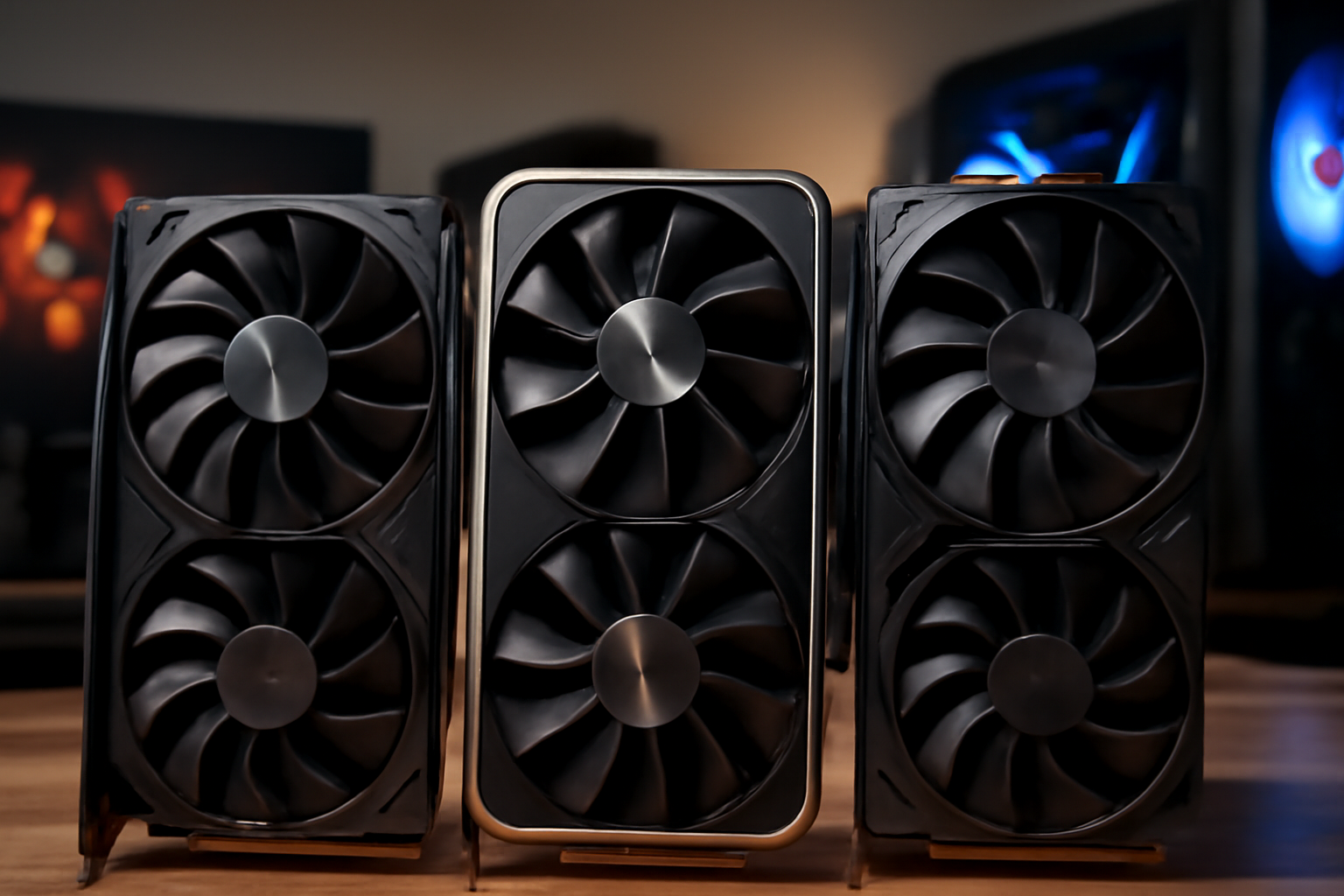
Graphics cards with efficient cooling systems ensure that the hardware operates within optimal temperature ranges even during intense gaming sessions. Overheating can lead to throttling, which diminishes performance and can also shorten the lifespan of the GPU. Cooling solutions come in various designs, including:
- Active Cooling Solutions: These typically involve fans that actively dissipate heat and are common in many high-end graphics cards. The quality and quantity of fans contribute to how well a card remains cool.
- Passive Cooling Solutions: These rely on heat sinks to absorb and disperse heat without the use of fans, resulting in a silent but often less effective cooling system.
- Liquid Cooling Systems: Though less common, some high-end cards include or support custom liquid cooling setups for superior heat management.
Equally important is the power consumption and power supply requirements of a graphics card. Modern GPUs can be power-hungry, and ensuring that your system’s power supply can deliver the necessary wattage is crucial. A lack of adequate power can result in instability or even hardware failure.
Factors affecting power include:
- TDP (Thermal Design Power): This indicates the heat dissipation and power consumption of a card and influences the type of power supply and cooling needed.
- Power Connectors: High-performance cards may require multiple power connectors or special types such as 8-pin or 12-pin, which must be supported by the power supply.
Ignoring these aspects could lead to suboptimal gaming experiences and unwarranted stress on system components. Consequently, gamers must find a balance between raw performance and a card’s cooling and power capabilities when choosing the ideal graphics setup.
Customising Your Experience: Overclocking and Modding GPUs
For enthusiasts seeking to maximise the performance of their graphics cards beyond factory settings, overclocking emerges as a prime technique. Overclocking involves pushing the core clock speeds and memory frequencies of the GPU above the manufacturer’s default specifications. Achieving higher clock speeds can lead to a marked improvement in frame rates and overall visual performance in demanding games and applications.
Before attempting overclocking, it is crucial to consider the cooling solution in place, as higher speeds result in increased thermal output. Aftermarket cooling solutions, such as liquid coolers or custom air coolers, can provide superior heat dissipation. Users who delve into overclocking must also be mindful of the potential implications on warranty and the risk of reducing the lifespan of their graphics card if done improperly.
Modding GPUs, whilst a less common practice, involves making physical modifications or using third-party software tweaks to enhance performance or aesthetics. Some enthusiasts may apply a bias mod to unlock higher power limits or replace the card’s thermal paste for improved heat conductivity. LED lighting or custom paint jobs can personalise the look of the GPU, aligning with the user’s preference and the overall theme of their rig.
Additionally, one can utilise software tools specific to their GPU brand, such as MSI Afterburner or EVGA Precision X1, which grants comprehensive control over the overclocking process and monitoring of the card’s vital statistics.
- Ensure the system’s power supply can handle the increased power draw.
- Incrementally increase clock speeds to establish a stable overclock.
- Monitor temperatures closely to prevent overheating.
- Perform stability tests after each adjustment to validate performance gains.
Balancing the desire for superior performance with the need for reliability and longevity is at the heart of customising one’s GPU experience.
The Verdict: Top Picks and Recommendations for Every Gamer
Choosing the right graphics card is critical to an exceptional gaming experience. Below are our top selections for various gamer needs:
For the Hardcore Gamer seeking the pinnacle of performance, the NVIDIA GeForce RTX 3080 Ti reigns supreme. Boasting formidable processing power, it delivers smooth, ultra-high-definition gameplay and is VR-ready.
The Enthusiast Gamer looking for high performance without the top-tier price tag should consider the AMD Radeon RX 6800 XT. It offers excellent value for money, with robust performance in 1440p and even 4K gaming.
The Budget-Conscious Gamer need not compromise on quality with the NVIDIA GeForce GTX 1660 Super. This card provides great 1080p performance with modest power requirements.
For the Eco-Conscious Gamer, the NVIDIA GeForce RTX 3070 presents a fine balance between power efficiency and gaming proficiency, making it a responsible choice that does not skimp on performance.
The Multi-Tasker Gamer who juggles gaming with creative workloads will appreciate the versatility of the NVIDIA GeForce RTX 3060 Ti. It’s powerful enough for gaming and optimized for tasks like video editing and 3D rendering.
Lastly, for the Mobile Gamer, the NVIDIA GeForce RTX 2080 Super Max-Q designed for laptops offers the best of both worlds—portability and power.
These recommendations cater to a wide spectrum of gaming preferences and budgets, ensuring every gamer can find their ideal graphics card from the top performers of the year. Choose wisely, and enhance your gaming journey with the graphics power that suits your play style and demands.
Upgrading Your Setup: Compatibility and Installation Tips
When it comes to upgrading your gaming setup with a top-performing graphics card, it’s vital to ensure compatibility with your existing system. To streamline the process, here are some essential compatibility and installation tips:
- Check Your Power Supply Unit (PSU): Graphics cards have different power requirements. Verify that your PSU has the necessary connectors and wattage to support your new card.
- PCI Express Compatibility: Ensure that your motherboard has the proper PCIe slot (usually x16) and that it’s compatible with the graphics card’s PCIe version to leverage the maximum performance.
- Physical Dimensions: Measure the clearance within your case. High-performance GPUs often occupy two expansion slots and can be quite lengthy, making it crucial to have enough room.
- System Bottlenecking: Pairing a powerful GPU with an outdated CPU may lead to bottlenecking where the CPU limits the full potential of the GPU. Consider the balance of your system components.
- BIOS Update: Occasionally, motherboards may require a BIOS update to recognize the latest graphics cards. Check your motherboard manufacturer’s website for updates.
For installation:
- Ground Yourself: To avoid static electricity damage, ground yourself by touching a metal part of the case before handling components.
- Remove Old Drivers: Before installing the new card, uninstall previous graphics drivers to prevent compatibility issues.
- Secure the Card: After inserting the graphics card into the PCIe slot, ensure it’s securely locked in and connect the necessary power cables.
- Driver Installation: Once the hardware is set up, install the latest drivers from the GPU manufacturer’s website for optimal performance and stability.
Always follow the manufacturer’s instructions for both compatibility checks and installation procedures to achieve the best results.
Conclusion: Investing Smartly in Your Gaming Future
When it comes to securing the best gaming experience for the years ahead, making a smart investment in a graphics card is paramount. The graphics cards discussed earlier in the article represent the peak of what 2023 has to offer, but users must consider future-proofing when making their selection.
Evaluate Longevity: Consider how the card’s performance will hold up against upcoming game releases and graphic enhancements. Opting for a card with the power to handle future advancements in gaming technology can save costly upgrades down the line.
Balance Performance with Budget: While the allure of top-tier graphics cards is undeniable, assess what works within your financial constraints without excessively compromising on quality.
Research Future Technologies: Stay informed on emerging graphics technologies and standards, such as ray tracing and AI-driven super sampling, and ensure your choice of card is equipped to handle these innovations.
Compatibility Considerations: Ensure your entire system, including power supply, cooling, and CPU, can support the demands of the chosen graphics card, foreseeing any potential bottlenecks.
Resale Value: Think about the potential resale value of the card. High-end cards with a reputation for quality and longevity often retain value better, providing a viable option for recouping some cost when it’s time to upgrade.
In conclusion, the right graphics card is an investment in your gaming future. The most judicious choice comes down to anticipating future gaming trends, understanding your system’s needs, and aligning them with your budget. Through thoughtful contemplation and strategic planning, you can ensure that your gaming rig remains a source of joy and competitive edge for years to come.