Comparison of Apples Budget Smartphones: Refurbished iPhone SE vs. iPhone 11
Comparison: Refurbished iPhone SE vs. iPhone 11
Als je op zoek bent naar een betaalbare en betrouwbare smartphone, zijn zowel de refurbished iPhone SE als de iPhone 11 uitstekende opties. Beide bieden geweldige prestaties, maar hebben verschillende kenmerken die ze uniek maken. Overweeg je een Apple product aan te schaffen? Bekijk dan onze uitgebreide collectie voor meer keuzes.
Here's an overview:
- Introduction to the budget-friendly world of Apple
- Why choose a refurbished smartphone?
- The Design: A visual comparison of iPhone SE and iPhone 11< /li>
- Performance: The power of the A13 Bionic chip in perspective
- [Cameras Compared: Quality vs. Quantity](#cameras-compared:-quality-vs.-quantity)
- Display and display-quality: How size and resolution play a role
- Battery-life and power-management: What's the most durable?
- Software and updates: Which device stays current longer?
- Storage options: How much do you really need?
- The value of connectivity: 4G versus 5G
- Durability and ease-of-repair: What's easier to maintain?
- Accessories and compatibility: From cases to AirPods
- Conclusion: The best choice for your needs
Introduction to the budget-friendly world of Apple
Apple is known worldwide for its innovative technologies and high-quality products. However, the premium price tags of the latest Apple devices may be a barrier for many consumers. However, there is a more budget-friendly alternative within the Apple ecosystem: refurbished smartphones. This category offers consumers the opportunity to enjoy the Apple experience at a significantly lower price.
Refurbished appliances, often referred to as ‘refurbished’, are used appliances that have been carefully checked, cleaned, repaired and where necessary fitted with new parts to return them to a condition close to new. When purchasing a refurbished iPhone from a certified seller, you can expect a reliable device that meets high standards of functionality and hygiene.
A few models stand out in this segment of the market, including the iPhone SE and the iPhone 11. The iPhone SE is known for its compact form factor and powerful performance, while the iPhone 11 is attractive for its more modern look and advanced camera capabilities. Both devices provide access to iOS, Apple's smooth and secure operating system, and are known for their long-term support for software updates.
The comparison of these two different models in the refurbished market is interesting for potential buyers who are looking for the best value for their money. On the one hand you have the iPhone SE, a device with a classic design and powerful performance for its size. On the other side is the iPhone 11, a device that offers more recent innovations and a larger screen.
In the following paragraphs, we will compare these two models in depth based on several criteria, such as price, performance, camera, battery life, and software, to determine which device may be the best buy for the budget-conscious Apple enthusiast.
Why choose a refurbished smartphone?
The market for refurbished smartphones is growing steadily and offers consumers a range of benefits. Here are some reasons why one might consider opting for a refurbished smartphone such as an iPhone SE or iPhone 11:
Cost savings: One of the most attractive aspects of refurbished phones is the cost savings. They are significantly cheaper than their brand new counterparts, meaning you can get access to technology that might otherwise be out of your budget for less.
Quality Control: At recognized refurbishers, phones undergo thorough quality control to ensure that they are as functionally reliable as a new device. Any defective parts have been replaced and the software is up to date.
Sustainability: By choosing a refurbished smartphone you make a positive contribution to the environment. Less demand for new devices means less production, resulting in fewer greenhouse gas emissions and less electronic waste.
Warranty: Many refurbished devices come with a warranty. Although this may not be as long as a new device, it still provides a form of security.
Technology: You can also enjoy recent technological developments with a refurbished model. The iPhone SE and iPhone 11, for example, still offer excellent performance, good cameras and regular iOS updates.
Availability: Refurbished models are often immediately available with no waiting lists, which can be especially useful if you need a replacement phone quickly.
Considering a refurbished smartphone can therefore be a smart and responsible choice that offers both financial benefits and contributes to sustainability.
The Design: A visual comparison of iPhone SE and iPhone 11
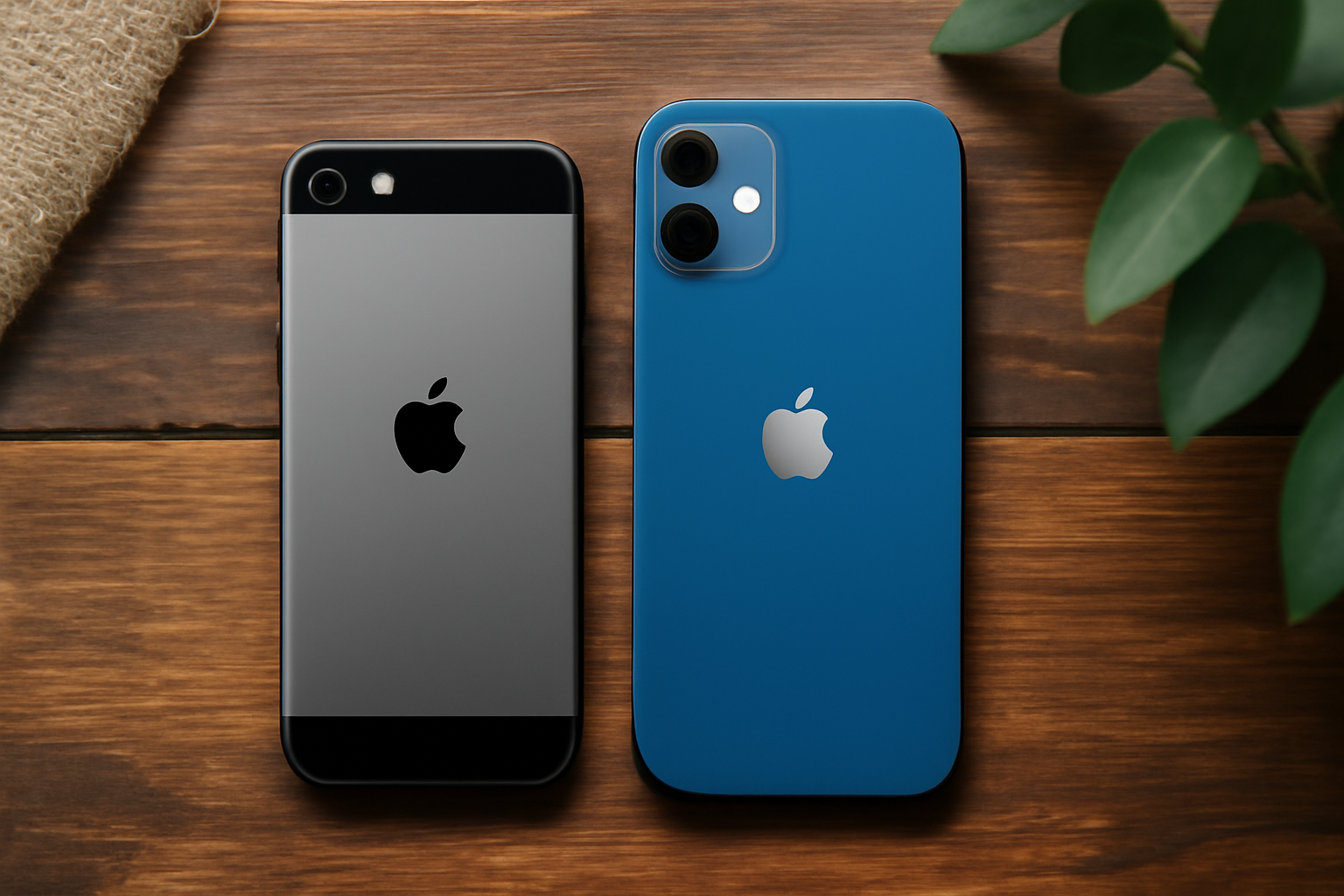
When choosing between the iPhone SE and the iPhone 11, it's clear that design is a significant factor that sets the two devices apart. Below is a detailed visual comparison of both models:
Format: The iPhone SE has a compact form factor with a 4.7-inch screen, making the device handy and suitable for one-handed use. The iPhone 11, on the other hand, offers a more spacious 6.1-inch screen, ideal for media consumption and gaming.
Screen type: The iPhone 11 uses a Liquid Retina HD display, while the iPhone SE is equipped with a Retina HD display. While both screens deliver bright and sharp images, the iPhone 11's Liquid Retina technology offers a wider color spectrum and improved viewing angles.
Bezels and Face ID:
- The iPhone SE has thicker bezels and retains the classic Home button with Touch ID.
- The iPhone 11 has a more modern design with thinner bezels and no Home button, instead offering Face ID for authentication.
Back and camera equipment:
- The iPhone SE has a single 12-megapixel rear camera, housed in a traditional design.
- The iPhone 11 features a dual-camera system with 12-megapixel ultra-wide-angle and wide-angle lenses, framed in a square camera module for a contemporary look.
Materials: Both the iPhone SE and the iPhone 11 have a glass back with an aluminum frame. However, the iPhone 11 has a more robust construction due to the use of tempered glass on both the front and back, unlike the iPhone SE which has a slightly less sturdy glass type.
Color options:
- The iPhone SE is available in traditional colors such as black, white and (PRODUCT)RED.
- The iPhone 11 offers a wider palette of colors, including pastel shades and more striking colors such as purple and green.
Aesthetic preference will play a decisive role, as the iPhone SE may appeal more to lovers of classic design, while the iPhone 11 has a more contemporary and fresh look that may appeal to a younger audience.
Performance: The power of the A13 Bionic chip in perspective
When Apple introduced the A13 Bionic chip, it was hailed as a quantum leap in mobile processing power. Both devices, the refurbished iPhone SE and the iPhone 11, are equipped with this powerful chip, which gives a good indication of their ability to perform.
Speed and Efficiency: The A13 Bionic chip, with its 6-core CPU and 4-core GPU, is known for its fast and efficient performance. These can effortlessly handle complex tasks such as gaming, video editing and the use of augmented reality (AR) applications.
Machine Learning and AI: The A13's Neural Engine has 8 cores and is optimized for machine learning (ML) tasks, contributing to the overall speed and intelligence of the device. This has a major impact on the way users interact with their smartphones, including photo enhancement features and facial recognition.
Energy efficiency: Another facet of this chip is the focus on preserving battery life. Despite its high performance, the A13 Bionic is designed to be energy efficient, allowing users to enjoy their devices for a longer period of time without having to constantly search for a charging point.
Software and Security Updates: The presence of the A13 Bionic chip also means that both devices can receive updates for longer, keeping them secure and taking advantage of the latest iOS features for the coming years.
Putting it into perspective, the A13 Bionic chip powers the refurbished iPhone SE and iPhone 11, providing a powerful foundation for a variety of use cases. Although the iPhone SE is smaller and may have less advanced hardware compared to the iPhone 11, the shared chip means that both devices are still competitive and relevant in today's smartphone market. This shared component assures users that they won't have to compromise on performance when choosing between these two budget-friendly Apple smartphones.
Cameras compared: Quality vs. Quantity
When weighing between the refurbished iPhone SE and the iPhone 11, camera power is a significant differentiating aspect. The iPhone SE, despite its position as a budget-friendly option, offers a respectable 12-megapixel main camera and a 1.2-megapixel front camera, both of which can deliver great photos and videos in good lighting conditions.
On the other hand, the iPhone 11 stands out with a dual-camera system at the rear, consisting of a 12-megapixel wide-angle lens and a 12-megapixel ultra-wide-angle lens, plus a 12-megapixel front camera. This setup not only enables deeper and more detailed photos, but also allows users to capture wider images and offers better low-light performance.
- The iPhone SE relies on the classic single-camera setup but still delivers high-quality photos for everyday use.
- The iPhone 11, with additional camera lenses, offers advanced features such as night mode, portrait mode with advanced bokeh and depth control, and 4K video recording with expanded dynamic range options.
In addition, iPhone 11 has next-generation smart HDR, which helps produce photos with higher dynamic range, capturing images with stunning detail in both light and dark areas. Additionally, iPhone 11 offers expanded videography capabilities, including improved image stabilization and the ability to capture wider footage, a welcome addition for video enthusiasts.
While the refurbished iPhone SE is a solid performer for its price point, the camera advantage clearly lies with the iPhone 11, which offers comprehensive quality and functionality to the photography enthusiast. The choice between quality and quantity would, thus, come down to the user's needs and preferences when capturing their daily moments.
Display and display quality: How size and resolution play a role
When choosing between the refurbished iPhone SE and the iPhone 11, it is important to consider the screen size and resolution as these factors have a major impact on the user experience. The screen is the window to all content and applications, and is therefore a crucial part of the smartphone.
The iPhone SE has a smaller 4.7-inch Retina HD display, resulting in a compact form factor that's ideal for users who want to operate a phone with one hand or prefer a smaller device. Although smaller in size, the SE's display delivers clear and sharp visualization with a resolution of 1334 by 750 pixels.
The iPhone 11, on the other hand, has a significantly larger 6.1-inch Liquid Retina HD display. This larger screen gives users more space for watching videos, playing games and performing other tasks. With a resolution of 1792 by 828 pixels, it also offers a higher pixel density than the SE, resulting in a sharper image.
When discussing display quality, technology must also be discussed. The iPhone 11 uses the newer Liquid Retina technology, which offers better color reproduction and wide viewing angles. Compared to the SE's traditional Retina display, this may provide a noticeably better viewing experience for some users.
In terms of brightness and contrast, the devices appear comparable; both support True Tone and wide color reproduction (P3), which is essential for users who value visual accuracy and comfortable color temperatures.
Finally, it is important for potential buyers to consider how the size and resolution of the displays can affect battery life, as a larger screen with a higher resolution generally requires more power. Nevertheless, the individual preference for screen size and quality remains a personal decision.
Battery life and power-management: What's the most durable?
When we compare the battery life and power management of Apple's budget smartphones, durability plays a crucial role. The refurbished iPhone SE, with its smaller size and efficient A9 chip, is known for its ability to save energy, allowing the battery to last longer on a single charge. Despite the smaller battery capacity, a well-maintained refurbished model can be surprisingly energy efficient, especially if the device is equipped with a new battery.
On the other hand, the iPhone 11 offers a larger battery and the advanced A13 Bionic chip, which is better at power management through machine learning and task optimization. The iPhone 11 also features an adaptive charging system that helps extend battery life by managing the charging process based on usage patterns.
For users who want to minimize environmental impact:
- Choosing a refurbished iPhone SE can contribute less to electronic waste.
- However, the iPhone 11 uses less energy per task due to more efficient components.
In addition, Apple offers a recycling program for both devices, which contributes to sustainability. Consumers focused on a lower carbon footprint should consider which device requires less charging and which option helps them avoid hardware obsolescence through software updates and the availability of replacement parts. All this helps extend its lifespan, which is ultimately more sustainable for the environment.
Software and updates: Which device stays current longer?
When choosing between the refurbished iPhone SE and the iPhone 11 as a budget smartphone, it is important to consider how long each device will continue to receive software updates. Apple is known for its long-term support for older devices, which is an important advantage when making a choice.
Apple Support: Historically, Apple has provided software updates for its iPhones for approximately five years. Based on the launch dates of the iPhone SE (first generation in 2016, second generation in 2020) and the iPhone 11 (introduced in 2019), one might expect the iPhone 11 to remain relevant for longer.
iOS Updates: The iPhone SE, with its older hardware, may be less technologically suited to smoothly running future, more demanding versions of iOS. The iPhone 11, with its newer A13 Bionic chip, will likely be better able to support new iOS features and provide a smoother user experience for longer.
Security updates: In addition to the annual major iOS updates, security updates are crucial to protect users against new threats. Newer devices like the iPhone 11 will likely receive security updates for longer than older models like the iPhone SE.
Overall, the iPhone 11 offers consumers a more future-proof investment when it comes to software updates and support. While the refurbished iPhone SE may be a good choice for the shorter term, the iPhone 11 will likely remain current for longer in terms of software, making it a better option for those who aren't looking to purchase a new device anytime soon.
Storage options: How much do you really need?
When considering the storage options of Apple's budget smartphones, it is crucial to analyze how much space the average user actually needs. The refurbished iPhone SE and the iPhone 11 present different storage capacities to suit different needs and budgets.
- The iPhone SE typically comes in variants of 32GB, 64GB or 128GB. For users who mainly make calls, send text messages and only use a handful of apps, a 32GB or 64GB model may be sufficient. However, those who like to keep photos and videos on their device will find that 128GB offers a more future-proof choice, and room for media without the constant worry of storage management.
- The iPhone 11, on the other hand, is available in 64GB, 128GB and 256GB variants. With the higher quality cameras on the iPhone 11, which can record 4K videos and take high-quality photos, the need for more memory becomes even more apparent. For avid photography enthusiasts or those who frequently download apps and games, even 128GB can be a tight squeeze.
It is also important to take the future into account. Apps are getting bigger and media resolutions are getting higher. The trend that people use their smartphones longer before upgrading also means that what is seen as sufficient now may no longer be enough in a few years.
Furthermore, one cannot ignore the fact that both devices do not offer an option for external storage, so one must make the right choice when purchasing. The decision depends on the individual usage pattern and anticipation of future needs. Careful consideration of current and future storage requirements will help determine which storage capacity is most appropriate, preventing you from quickly reaching the device's limits.
The value of connectivity: 4G versus 5G
When choosing between a refurbished iPhone SE and an iPhone 11, connectivity plays a crucial role in the decision-making process. 4G and 5G networks are central.
- 4G LTE Technology: The iPhone SE supports 4G LTE. This network already offers decent speeds that are sufficient for everyday tasks such as browsing, streaming and media sharing. Although 4G is significantly faster than its predecessor, 3G, it has almost reached its peak in innovation and speed improvements.
The value of 4G is proven and reliable, especially in places where 5G is not yet available.
- 5G Technology: On the other hand, with the emergence of the iPhone 11, the transition to 5G, the next generation of mobile networks, becomes a reality. 5G not only promises faster download and upload speeds, but also lower latency and the potential for a greater number of connected devices per square kilometer. This could have a significant impact on high-resolution streaming, online gaming and the use of augmented reality applications.
5G is still in its infancy, but its potential for the future is enormous.
The main difference between 4G and 5G in the context of these smartphones is their long-term value. The refurbished iPhone SE offers a stable, well-developed 4G experience. However, when looking at future innovations and the steady rollout of 5G networks, the iPhone 11 with 5G connectivity represents an investment in future technologies.
The choice between 4G and 5G can also depend on personal circumstances. Those who live in an area where 5G is not yet available will benefit most from the stable 4G performance of the iPhone SE. Consumers who live in urban centers with 5G coverage, or who want to invest in a device that's ready for the future, could find more value in the iPhone 11. It comes down to a trade-off between the out-of-the-box reliability and cost savings of 4G, and the longer-term perspectives that 5G offers.
Durability and ease of repair: What is easier to maintain?
When comparing the iPhone SE and iPhone 11 in terms of durability and ease of maintenance, it is important to look at build quality, parts availability and design for repairs.
Build quality:
- The iPhone SE has a glass front and an aluminum back, which can generally be considered robust.
- The iPhone 11 has both a glass front and back, with the glass used being claimed as the strongest glass in a smartphone. This can reduce the risk of damage in the event of a fall.
Parts availability:
- Parts for the iPhone SE are generally readily available, partly because the design has been on the market for a while.
- Parts may be easier to find for the iPhone 11 given its more recent release and larger install base.
Design and ease of repair:
- The iPhone SE scores reasonably well on ease of repair because it has a somewhat simpler design without Face ID and other complex components.
- The iPhone 11 is more complicated to repair due to more advanced technologies such as Face ID, which may mean special tools or knowledge are required to perform certain repairs.
Research and reports from repair specialists show that both devices have their advantages and disadvantages. For example, the iPhone SE is known for its sturdy build and easier repairs, but its older design may mean that certain newer updates or repair techniques are not available. The iPhone 11, on the other hand, has the benefits of more modern technology but with the added complexity that can make repairs more difficult and potentially expensive.
Considering which is easier to maintain, the balance tips slightly in favor of the iPhone SE. However, the choice in this area will ultimately depend on individual preferences and the willingness to undertake more complex repairs or to appreciate the convenience of the more robust iPhone SE.
Accessories and compatibility: From cases to AirPods
When choosing between the refurbished iPhone SE or the iPhone 11, it is important to consider accessories and compatibility. Accessories can improve the user experience and provide protection to the device.
Cases: The iPhone 11, with its 6.1-inch display, requires larger cases than the compact iPhone SE, which has a 4.7-inch screen. Due to their different sizes, covers are not interchangeable between these models. Switching users must purchase new cases that match the chosen model.
Screen protectors: As with cases, one must purchase a suitable screen protector for each phone. The iPhone SE and iPhone 11 have different screen sizes, meaning screen protectors cannot be used universally between these two devices.
Chargers: Both phones support Lightning connectors for charging and syncing, but only the iPhone 11 supports wireless charging. Users who want the convenience of wireless charging should prefer the iPhone 11.
EarPods and AirPods: EarPods with a Lightning connector are included with both models, but the experience with the AirPods qualifies to a higher level of audio enjoyment and convenience. AirPods are compatible with both the iPhone SE and iPhone 11 and can provide a seamless experience with the latest generation of Bluetooth connectivity.
Smart Battery Cases: Apple offers Smart Battery Cases for newer iPhones, including the iPhone 11. These extend battery life and provide a girl with protection. For the iPhone SE, users should consider alternative battery cases from third parties as there is no official version from Apple.
To ensure the most optimal and personalized experience, it is recommended that users research compatible accessories for their model of choice. It is important to pay attention to both functionality and physical dimensions.
Conclusion: The best choice for your needs
When considering a refurbished iPhone SE and an iPhone 11, individual needs play the biggest role in choosing which smartphone suits you best. Below is a consideration of some crucial points to help you make this decision.
Price: If budget is your main concern, a refurbished iPhone SE usually offers the best price. This one is an excellent option for those who want an Apple device without breaking the bank.
Performance and Camera: For users who value performance, camera quality and longer support for software updates, the iPhone 11 is the better choice. Thanks to the A13 Bionic chip and the dual camera system, it offers a significantly better experience.
Screen size: The iPhone 11 has a larger screen, which can be an advantage if you often watch videos or play games. For those who prefer compactness and a device that is easy to operate with one hand, the iPhone SE is a better fit.
Battery life: The iPhone 11 has a longer battery life than the iPhone SE. This can be important for people who use their phone intensively and do not often have the opportunity to charge it in between.
Future-proof: How important is the lifespan of the phone to you? The iPhone 11 is expected to receive updates for longer than the iPhone SE, meaning it could be a better long-term investment.
Finally, your choice should also be guided by what features you value most — whether it's cost, the latest technology or the size of the device. Each of these smartphones has its own strengths and can perfectly meet different types of users and their specific needs.